From Sidewall to Icon: The Origins of Vans Checkerboard
The rise of the iconic pattern during the ‘80s.
2026-04-01
Words by Global Brand Archivist and Historian Catherine Acosta.
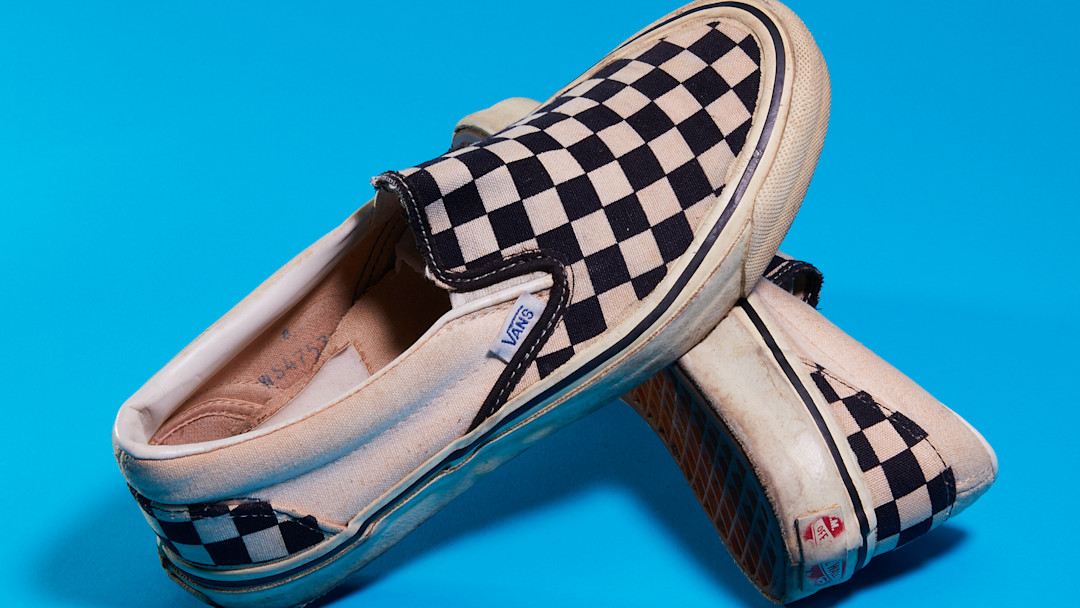
Visually bold and instantly recognizable, the Checkerboard pattern has shown up in cultures around the world for centuries. For Vans, it’s become a symbol of creativity and cultural connection—one that really took off in the early ’80s when the pattern first appeared on the rubber sidewalls of Vans shoes. Patterns like this, which appeared on the rubber sidewalls of Vans shoes, were known as “Friction Scenes.”
Beginning in the late ’70s and continuing into the early ’80s, Steve Van Doren—the son of lead co-founder Paul Van Doren—managed 27 of the roughly 50 Vans stores in Southern California. During this period, he hosted in-store contests inviting kids to submit their own ideas for Friction Scenes. According to Steve, he recalls seeing kids draw checkerboard patterns on the sidewalls of their Vans, but those designs were never submitted as part of the contests. Nonetheless, this was the general time frame in which checkerboard emerged as a rubber sidewall pattern.
In 1981, Vans officially trademarked checkerboard as a design motif for its sidewalls, listing April 6, 1981, as the first date of use. That filing marks one of the earliest documented moments of checkerboard becoming part of Vans history and a defining element of California design—shortly before it evolved into a canvas print for Vans shoes.
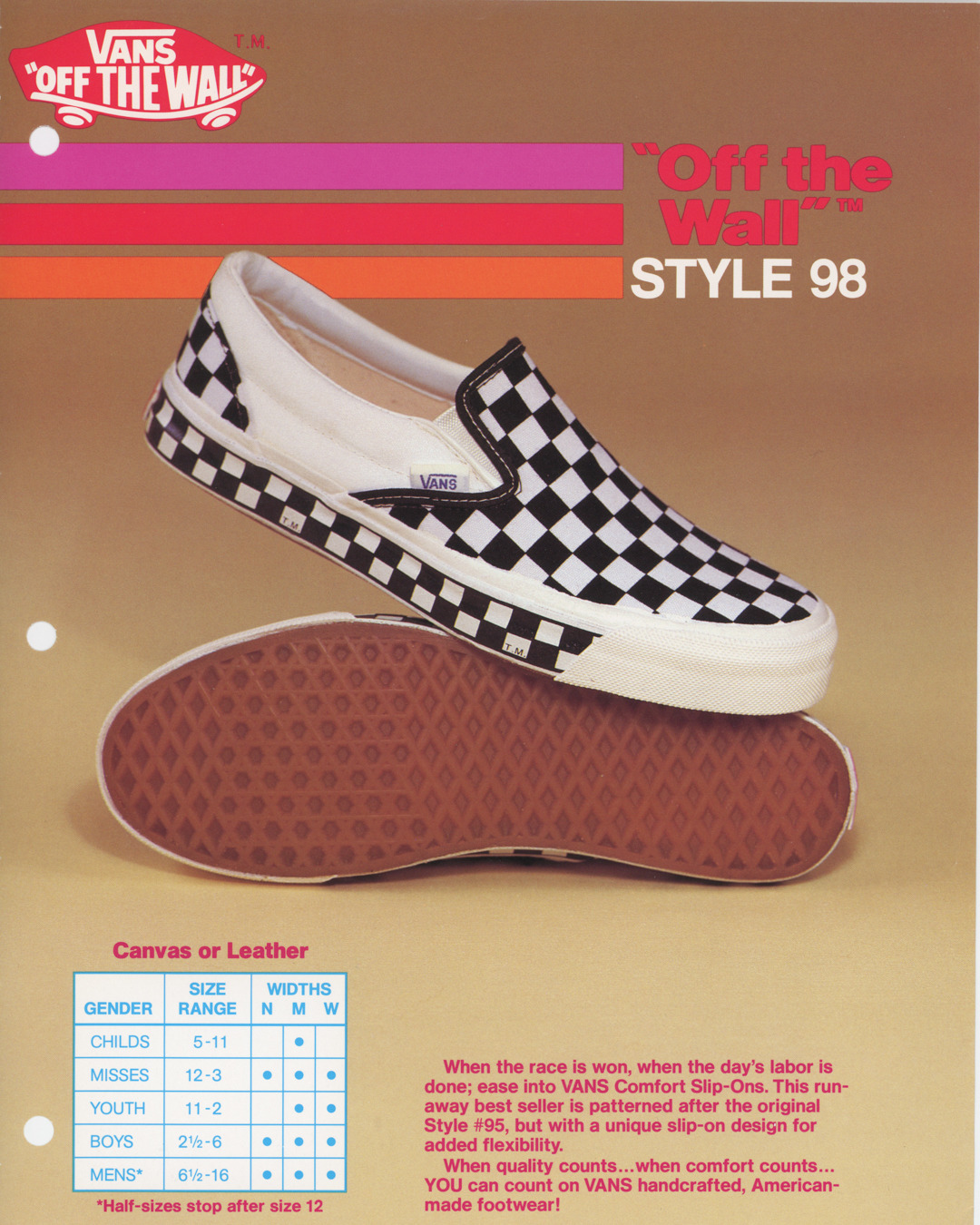
Inspired by its usage in car racing and motocross, checkerboard quickly found a home in the BMX community in the early ‘80s. It took off fast—appearing on Vans BMX Team uniforms, apparel, and, of course, shoes. Many of Vans’ archival prints pull directly from the subcultures that shaped the brand’s identity—skateboarding, surfing, BMX—as well as design cues from American pop culture. These influences helped define the colors, motifs, and visual language Vans is known for today. And among all those design touchpoints, none stands out more than the iconic black-and-white checkerboard.
Then, in 1982, the Checkerboard Slip‑On made its way into pop culture history when Sean Penn’s character Jeff Spicoli wore a pair in Fast Times at Ridgemont High. The shoes appeared throughout the film, showed up on the movie poster, and even landed on the soundtrack cover, launching checkerboard straight into the mainstream. From that moment on, it became a defining symbol of Vans, reimagined in countless colorways and versions and recognized around the world.
Catherine Acosta is an archivist, educator, and historian based in Los Angeles, California. She is the Global Brand Archivist and Historian for Vans, the iconic Southern California footwear and action sports brand, where she preserves and interprets the company’s cultural and design legacy.
Related Content

Drops
VANSZA
2026-10-15
VANS AND SZA DEBUT CAMPAIGN - Inspired by SZA's World, Where Nature, Creativity & Self-Expression Collide
Read more
Guides
Halloween-Inspired Outfits for Everyday
2026-10-15
Outfit Idea #2: Graphic Tees A killer graphic tee does all the heavy lifting when you want to show off your personality. Look for designs that lean into retro horror, glowing skull prints, subtle spi
Read more
Drops
OTW by Vans x Satoshi Nakamoto
2026-10-14
OTW by Vans extends its creative partnership with Satoshi Nakamoto introducing the Era 95 Gems. Building on their shared foundation of experimentation and subversive design, the latest collaboration r
Read more
Surf
Tom Lowe: From Cornwall to Big Wave Surfer of the Year
2026-10-10
Cornish-born, Raglan-based Vans surfer Tom Lowe on Ireland’s slabs, two near-fatal Tahiti accidents, fatherhood and what keeps him chasing swells.
Read more